Unique Wedding Rings: 7 Styles That Defy Tradition
unique wedding rings
Table of Contents
Couples searching for unique wedding rings typically want bands that reflect a shared identity rather than follow a standard catalog. The intent is personal expression through material science and design engineering, not just aesthetics. This guide breaks down the structural and stylistic options that separate distinctive bands from mass-market inventory.
Why Couples Choose unique wedding rings Over Classic Bands
Standard gold bands dominate the market because they are easy to manufacture and size. However, they often lack the wear resistance or visual weight required for active lifestyles. Modern metallurgy offers alternatives that outperform traditional precious metals in hardness and scratch resistance. According to data from the Jewelers of America bench jeweler surveys, alternative metals now account for a significant portion of men’s wedding band sales, driven by durability demands.
Unique Wedding Rings Material Science Drives Durability
Tungsten carbide ranks roughly 9 on the Mohs hardness scale, making it virtually scratch-proof. Ceramic offers similar hardness with a lighter weight profile. Tantalum sits in a sweet spot: it is hypoallergenic, shatter-resistant unlike tungsten, and carries a natural gunmetal grey patina that does not require plating. Cobalt chrome mimics the look of white gold but exceeds platinum in hardness. These are not fleeting fads; they are industrial materials adapted for daily wear.
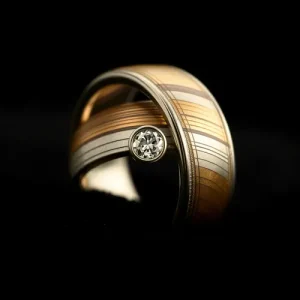
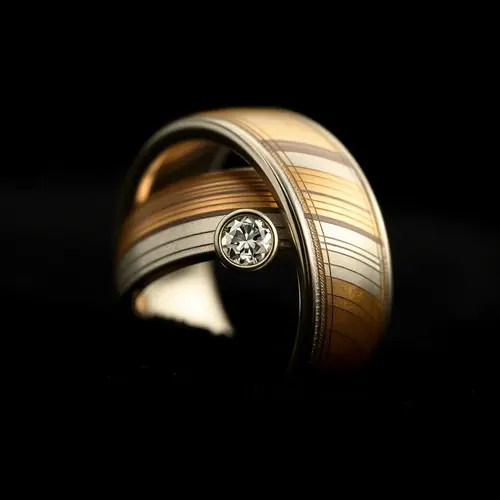
Mokume Gane: Wood-Grain Unique Wedding Rings Metalwork
This Japanese metalsmithing technique fuses layers of contrasting alloys—typically silver, copper, and gold—then forges and twists them to reveal organic wood-grain patterns. No two billets are identical. The process requires a master metalsmith; it cannot be cast. As noted in GIA (Gemological Institute of America) coursework on specialty metals, true Mokume Gane represents the highest tier of fabrication skill in the trade.
| Material | Mohs Hardness | Weight Feel | Hypoallergenic | Resizable |
|---|---|---|---|---|
| Tungsten Carbide | 8.5 – 9 | Heavy | Yes (Nickel binder) | No |
| Tantalum | 6.5 | Heavy | Yes | Yes (Limited) |
| Cobalt Chrome | 7 – 8 | Medium | Yes | Yes (Difficult) |
| 14k/18k Gold | 2.5 – 3 | Medium | Varies by alloy | Yes |
| Platinum 950 | 3.5 – 4 | Heavy | Yes | Yes |
Unique Wedding Rings Design Mechanics: Tension Settings and Structural Integrity
A tension setting holds a center stone through compressive force exerted by the band itself. The metal acts as a spring. This requires precise calibration; the band must be sized perfectly before the stone is set because resizing alters the spring tension and risks stone loss. This is a critical technical detail often missed in retail presentations. If a client fluctuates in weight, a tension setting is a liability. A bezel or flush setting offers similar visual minimalism with structural forgiveness.
Unique Wedding Rings Insight: The Resizing Myth
Many retailers claim alternative metals “cannot be cut off in an emergency.” This is outdated. Emergency rooms carry diamond-coated rotary tools that remove tungsten, ceramic, and cobalt chrome in seconds. The real constraint is resizing. Tungsten and ceramic cannot be stretched or compressed. Tantalum and cobalt chrome allow minor adjustments—typically a quarter size up or down—via specialized laser welding. Always verify the manufacturer’s sizing policy before purchase.
Sourcing Ethical Stones for unique wedding rings
Salt and pepper diamonds have surged because they celebrate inclusions rather than hide them. Their polycrystalline structure creates a galaxy-like depth unmatched by flawless stones. They cost significantly less per carat than high-clarity diamonds, allowing budget allocation toward custom fabrication. Moissanite remains the premier diamond simulant; its refractive index (2.65) exceeds diamond (2.42), producing more fire. Lab-grown diamonds are chemically identical to mined stones. The Federal Trade Commission mandates clear disclosure, but optically and physically, they are the same material.
Lab-Grown vs. Mined: A Technical Unique Wedding Rings Comparison
- Crystal Structure: Identical cubic crystal system.
- Hardness: Both 10 on Mohs scale.
- Trace Elements: Lab stones may show distinct growth patterns under magnification (HPHT vs CVD), detectable only by advanced gemological equipment.
- Value Retention: Mined stones hold resale value better historically; lab stones depreciate faster due to production scaling.
Custom Unique Wedding Rings Fabrication Checklist
Commissioning a bespoke band involves distinct phases. Skipping steps leads to costly remakes.
- Profile Selection: Flat, court (domed), knife-edge, or comfort-fit. Comfort-fit adds interior rounding; essential for bands wider than 6mm.
- Width vs. Finger Size: Wide bands fit tighter. Order a half-size larger than measured for widths over 8mm.
- Engraving Depth: Laser etching works on all metals. Hand engraving requires minimum 1.8mm wall thickness to avoid breakthrough.
- Metal Compatibility: Do not solder two different karat golds directly without a transition alloy; galvanic corrosion will occur at the seam.
- Warranty Scope: Confirm coverage for stone tightening, rhodium replating (if white gold), and lifetime sizing for precious metals.
Final Thoughts on Unique Wedding Rings Selection
The most successful purchases align material properties with the wearer’s daily reality. A mechanic needs tantalum or cobalt chrome, not a high-polish gold band that will mar in a week. An office professional might prefer the patina development of a Mokume Gane ring. Choosing unique wedding rings means prioritizing metallurgy and engineering over marketing categories. That approach yields a band that survives decades of wear while looking better with age.

Bellinda Taylor is a senior wedding editor at Best Wedding covering reception design, jewelry, and guest experience. 7+ years, 150+ guides. Method: vendor contracts, trend forecasts, and logistics data. Author of 2,263 wedding guides since 2022.